

How To Choose The Right Cable Machines 2026
By Derek Frost
A cable machine can add serious value to a home gym, but only if you use it for the work it does best. The wrong station wastes floor space, caps your progression, and turns every set into a fight with poor setup. Choose based on resistance, adjustability, stability, and how well the machine complements your heavy free-weight training.
Quick Answer
Choose a cable machine with adjustable pulleys, a secure setup, enough maximum resistance to support your progression, and a footprint that does not crowd your rack or bench. Use it for constant-tension isolation work, controlled reps, angle changes, supersets, and drop sets; keep a power rack, barbell, dumbbells, or other free weights for very heavy compound training. If the weight stack caps your loading or the machine cannot adjust to your body, it is the wrong tool no matter how many attachments it includes.
Table of Contents
Our Top Picks
Affiliate disclosure: if you buy through these links, we may earn a commission at no extra cost to you.



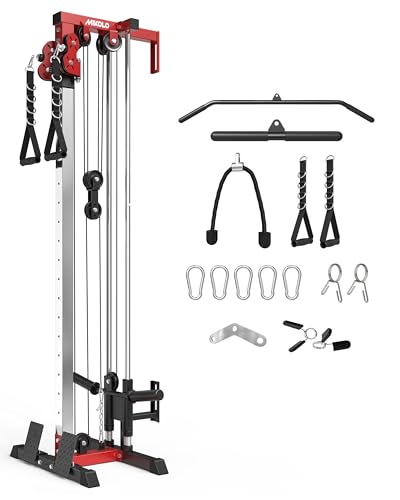
Start With the Resistance Curve
Cable machines provide tension throughout a movement’s range of motion. Free weights rely on gravity, so the resistance curve changes with body position and exercise angle. That difference is the entire reason to own a cable station. It is not automatically better than a barbell or dumbbell. It is better for specific jobs.
Cables are especially useful for isolation work, controlled movement patterns, drop sets, supersets, and angles that are difficult to reproduce with free weights. A cable fly can finish a pressing session without requiring another heavy barbell set. A cable lateral raise keeps the shoulder working through a controlled path. A leg extension gives the quadriceps direct work after squats or leg presses.
The exercise range is broad. RevyFit catalogs 56 cable-machine exercises across 12 muscle groups, including 37 identified as beginner-friendly. Its exercise ratings place the cable fly at approximately 90% chest and the cable lateral raise at approximately 90% shoulders, while the leg extension is rated at approximately 95% quadriceps. Treat those figures as targeting guidance, not a guarantee that every lifter will feel the same movement in the same place.
Make the Cable Station Earn Its Footprint
A cable machine should fill a gap in your home gym, not pretend to be the whole gym. Your power rack or squat rack and barbell handle heavy squats, presses, and other compound lifts. A weight bench supports pressing and seated work. Dumbbells and kettlebells cover unilateral training and free-weight variations. A pull-up bar handles bodyweight pulling, while resistance bands are useful for warm-ups, activation work, and travel. Bumper plates belong under the barbell on suitable gym flooring. The cable station earns its space by adding controlled tension and exercise angles those tools do not provide as efficiently.
Performance starts with the machine’s actual specifications. Pay attention to maximum resistance, steel gauge, footprint, warranty, and value per dollar. Those details matter more than a long attachment list. A station with a limited selectorized stack may be fine for moderate accessory work but inadequate for stronger lifters who continue progressing on rows, pulldowns, presses, or leg movements. A machine that flexes, shifts, or offers poor adjustment range is not a bargain. It is expensive dead weight.
Match the station to the way you train. If your priority is a heavy barbell squat, deadlift, bench press, or overhead press, the cable machine should support that program rather than replace it. If your training revolves around bodybuilding-style volume, controlled repetitions, and frequent supersets, quick resistance changes and multiple usable pulley positions become more valuable. The right choice is the station that gets used consistently without compromising the rest of the room.
Set the Machine Before You Set the Weight
Machine adjustment is not a warm-up ritual. It determines whether the resistance follows the intended movement path. Before starting, adjust the seat height, back-support position, pulley height, and resistance setting. Then check the weight-stack pin. If the pin is not fully inserted or the adjustment mechanism is not secure, the set does not start.
Use the seat and back support to put your joints in a repeatable position. Keep your feet firmly planted. Engage your core. Maintain alignment through the working joints instead of twisting toward the handle. If the pulley is too high or too low, the line of pull can change the exercise and shift stress away from the target muscle.
Start with lighter resistance when changing an exercise, pulley height, or seat position. Cable machines make it easy to add weight before you have learned the path. That is how lifters turn a controlled lateral raise into a shrug, or a cable fly into a jerky shoulder movement. Smooth repetitions and a full controlled range of motion matter more than the number on the stack.
Program Cable Work Where It Pays Off
Cable training works best as part of a complete strength program. Put heavy compound lifts first when they are a priority, then use cables for targeted volume. After barbell bench press, cable flyes can train the chest with controlled tension. After squats, a leg extension can add direct quadriceps work without another demanding compound set. After pull-ups or barbell rows, cable work can add upper-back or arm volume without requiring another heavy free-weight movement.
Cables are also useful when you want to keep training density high. Quick resistance changes make drop sets and supersets practical. That is valuable when you are pushing accessory work at a challenging RPE but do not want to waste several minutes changing plates. Do not chase a cable-machine 1RM. Use a load that lets you keep posture, alignment, and control from the first rep to the last.
ClickGym recommends cable training two to three times per week, using three to four sets per exercise. For muscle building, its general recommendation is eight to twelve repetitions; for endurance, twelve to fifteen repetitions. Rest periods of 30 to 60 seconds can work for this style of accessory training. Use those numbers as a starting structure, then adjust based on recovery, exercise selection, and whether your technique stays solid.
Avoid the Mistakes That Make Cables Useless
The most common cable-machine mistake is excessive resistance. Lifters see a stack and try to move it instead of training the target muscle. Poor posture, jerky repetitions, and shortened range of motion usually follow. A cable machine does not make bad technique safe. It simply gives bad technique a smoother-looking handle.
Do not skip the setup check. Warm up before hard work. Confirm that the weight-stack pin, seat, back support, and pulley adjustments are secure. Begin with lighter resistance when learning a movement, and progress gradually. Keep your feet planted, brace your trunk, maintain alignment, and use smooth movement. Avoid holding your breath for the entire set; control your breathing while keeping your torso stable.
Cable machines also have clear limitations. They require a dedicated station and usable floor space. They may be less effective for very heavy compound movements, and a selectorized weight stack can eventually become inadequate for a stronger lifter. That is not a defect in every cable machine. It is a reminder to use the tool correctly. Keep the power rack, barbell, dumbbells, kettlebells, pull-up bar, and other free-weight equipment in the program when they are the better fit.
Frequently Asked Questions
Are cable machines better than free weights?
Neither is automatically better. Cable machines provide constant tension, controlled resistance, and more angle options for isolation work. Barbells and dumbbells remain better tools for many heavy compound lifts and 1RM-focused training.
Can a cable machine replace a power rack or squat rack?
No. A cable station is not a substitute for a rack and barbell when heavy squats, presses, or other compound movements are central to your program. Use cables to add targeted accessory work and controlled volume.
How much maximum resistance should a cable machine have?
It should provide enough resistance for your current exercises while leaving room to progress. Stronger lifters need to examine the maximum resistance carefully because a limited selectorized stack can become inadequate, especially on movements where they can handle heavier loads.
How often should I train with a cable machine?
ClickGym recommends two to three cable-training sessions per week, with three to four sets per exercise. A useful starting range is eight to twelve repetitions for muscle building or twelve to fifteen for endurance, with 30 to 60 seconds of rest.
Why do cable exercises feel different from dumbbell exercises?
The resistance source and curve are different. Cables can maintain tension through more of the movement and let you change the angle of resistance. Dumbbells rely on gravity, so the challenge changes with your body position.
What should I check before starting a cable exercise?
Adjust the seat, back support, pulley, and resistance. Verify that the pin and other settings are secure. Warm up, begin with lighter resistance, keep your feet planted, maintain alignment, and use smooth controlled repetitions.
Conclusion
The right cable machine is not the one with the most attachments or the biggest marketing claims. It is the one with enough usable resistance, reliable adjustment points, a secure setup, and a footprint that works beside your rack, bench, barbell, and other equipment. Use it for constant-tension isolation work, controlled volume, supersets, drop sets, and angle variety. Before your next session, choose one cable exercise that fills a real gap in your program, set the machine carefully with a light load, and log the position, resistance, repetitions, and technique you can repeat.


